Music Piano 7: Rush Song Games
- 4.8
- Rating
- 50.00M
- Installs
- Free
- Price
 Analysis by App-foxy
I spent time with Music Piano 7: Rush Song Games as a quick music game rather than treating it like a piano-learning tool. That distinction matters. The game is built around tapping along with songs, chasing a clean run, and reacting before the next tile disappears from reach. It is free to download, so the first question is not whether it is worth buying, but whether its free access gives you enough enjoyable play to justify keeping it on your phone.
My short answer is yes, if you want a lightweight rhythm challenge that fits into spare moments. I would not recommend it to someone looking for proper keyboard practice, deep music theory, or the same control offered by a full rhythm-game setup. Its appeal is immediate: open it, choose a song, and test your timing. Its weakness is just as clear: the format can become repetitive when you want more variety than tapping patterns and rising difficulty can provide.
How Music Piano 7 turns songs into a quick reflex challenge
The game comes from Melodya Muses and sits in the music category. Its central idea is easy to understand: tiles move toward the point where you need to tap them, and your job is to keep pace with the selected track. The piano theme gives the experience a familiar shape, but I found the real skill to be visual timing. You are not learning where notes sit on a real keyboard; you are learning to connect what you see with the next beat.
You May Also Like

 AccuWeather: Weather Radar
AccuWeather Review: A Quick, Clear Forecast for Everyday Decisions
For everyday plans, the best forecast is the one you can understand quickly. AccuWeather makes rain timing, radar, and local conditions easy to act on, with a few trade-offs.

 Hill Climb Racing
Why Hill Climb Racing Still Turns Crashes Into One More Run
A tiny car, a bumpy hill and one more upgrade: Hill Climb Racing keeps resurfacing because its simple chaos makes every near-miss feel personal.

 AliExpress - Shopping App
AliExpress Makes Global Shopping Feel Personal, but Shoppers Bear the Risk
AliExpress turns a global marketplace into a pocket-sized discovery engine. Its reach is useful, its shopping loop compelling, and its trade-offs easy to miss.

 Lords Mobile: Kingdom Wars
Lords Mobile Is a Kingdom-Building Routine, Not a Quick Match
A case-by-case verdict on the building, battles, device demands, and social commitments that make Lords Mobile rewarding for some players and exhausting for others.

 PDF Scanner app - TapScanner
TapScanner Makes Paperwork Easier to Capture, Check, and Share
TapScanner makes scanning with a phone feel less like a rescue operation and more like a dependable step in getting work done. Its capture tools are useful, though not flawless.

 Block Blast!
 Shows How Much a Puzzle Game Can Leave Out
A quiet grid game shows why puzzle players increasingly value instant clarity, repeatable skill and low-pressure play—and where the genre still needs to catch up.
More From Our News Desk
View All News


That makes the opening minutes approachable. I did not need a tutorial-heavy explanation before playing, and the basic interaction is suitable for a broad audience. The content rating is Everyone, which fits the uncomplicated presentation and music-focused challenge. A child can understand the objective quickly, while an adult can use the same structure for a short break without having to remember a complicated control scheme.
The important change from song to song is not simply the melody. The pressure comes from how quickly the tiles arrive, how much attention the pattern demands, and whether a familiar tune encourages you to tap from memory instead of watching carefully. That last point is a useful trap. Recognizing a song can make you feel prepared, but the game still rewards the exact visual rhythm in front of you.
I recommend beginning with a relaxed posture and using both hands only when the screen layout makes that comfortable. For shorter sessions, one hand is convenient, especially when standing on public transport or waiting in a queue. For difficult passages, two thumbs can reduce the distance between taps, although they also make it easier to cover part of the screen or lose your place. The best setup is the one that keeps your view clear rather than the one that looks most like playing a piano.
What the free entry point means in practice
The game is listed as free, so you can try its core appeal without committing money at the start. That is a meaningful advantage for this type of app because rhythm games are personal: the same song-based tapping loop that feels absorbing to one person can feel monotonous to another. Free access lets you make that judgment through actual play instead of relying on screenshots or a short description.
I would be careful, however, about confusing free access with unlimited value. The verified price tells me that downloading the game does not require a purchase, but it does not establish that every possible item, progression option, or later choice is included without conditions. I therefore judge the free version by the basic play experience rather than promising that every part of the game is permanently open.
That is also why I would not describe it as a substitute for a paid music game with a clearly defined package. If you prefer to pay once and know exactly what you receive, you may be more comfortable with a premium alternative whose catalog and progression are presented as a fixed product. Here, the strongest financial argument is simple: there is no upfront cost blocking experimentation.
The app has reached over 50 million installs and holds a 4.8 average from around 270 thousand ratings, with roughly 1.6 thousand written reviews. Those figures suggest that the basic concept has connected with a large audience, but they should not replace your own test. A popular rhythm loop can still be the wrong fit if you dislike repeated attempts, fast visual cues, or playing with touch controls.
Where the value comes from beyond the song list
For me, the value is in how little preparation the game demands. I can use it during a short pause when a longer game would be inconvenient. There is no need to build a character, learn a map, or remember a story. The reward comes from improving a run, reaching a more demanding section, and noticing that a pattern which felt impossible becomes manageable after a few attempts.
That creates a useful personal routine. If I have only a few minutes, I choose one song and treat it as a focused timing exercise rather than jumping between many choices. If I have longer, I change the difficulty of my attention instead of simply playing faster: first I watch the whole lane, then I concentrate on the next two or three tiles, and finally I try to keep the rhythm without anticipating the screen. This approach gives the same short game more depth than simply tapping until I miss.
A less obvious strength is that the game can work as a reaction warm-up. I would not call it a scientific training tool, but the repeated connection between sound, movement, and touch makes it a pleasant way to switch into a focused state. I sometimes find that a brief session is enough to wake me up before studying or doing a task that requires concentration. The benefit is psychological and practical, not a promise of improved musical ability.
Another useful habit is to play with notifications silenced when possible. A rhythm game depends on an uninterrupted visual and audio loop, and even a small interruption can turn a fair mistake into a frustrating one. This is not a special feature; it is a simple way to protect the experience. I also prefer headphones in a quiet setting, but the game is more convenient when I can play without setting up external equipment.
Why it is not the same as learning piano
The piano presentation may attract people who want to improve their musicianship, but the game should be approached as a rhythm challenge. Tapping a moving tile can reinforce a sense of pulse and hand coordination, yet it does not teach finger independence on a real keyboard, reading notation, chord construction, or expressive control. If your goal is to play a song on an actual piano, a lesson app or structured practice method is a better investment of time.
That difference does not make the game misleading in my view; it simply defines the right expectation. I enjoyed it more once I stopped asking whether I was becoming a pianist and started asking whether I could follow the next pattern accurately. The game rewards immediate response, not the broader skills needed to perform music. Someone who understands that will probably find the format more satisfying.
It also differs from a traditional rhythm game that uses a large library of licensed tracks, elaborate visual effects, or a competitive online structure. Music Piano 7 is more attractive when you want a direct touch-screen loop. A console-style rhythm title may offer deeper systems and more dramatic presentation, while a piano-learning app may offer better long-term instruction. This game occupies the smaller, faster space between those two uses.
Tradeoffs that become clear after repeated sessions
The first tradeoff is simplicity versus depth. The uncomplicated controls are the reason I can start playing immediately, but they also limit how much the game can evolve for a committed player. Once the novelty of the tapping format settles, your motivation depends heavily on enjoying the songs and chasing cleaner performances. If you need character development, a detailed campaign, or several distinct gameplay modes, this may feel narrow.
The second tradeoff is speed versus comfort. Faster sections are exciting when your eyes and fingers agree, but they can become tiring when the screen demands constant concentration. I found that short sessions work better than forcing a long run after my attention has dropped. Continuing while tense usually produces rushed taps, and those mistakes feel less like a meaningful challenge than a sign that I should take a break.
Screen size also affects the experience. On a compact phone, the game is easy to carry but gives your thumbs less room to stay out of the way. A larger display can make patterns easier to read, although it may require more finger movement. If you mainly play one-handed, check whether your preferred grip leaves enough of the play area visible. This is a practical consideration that screenshots rarely communicate.
Sound is another tradeoff. The music is central to the mood, but the visual timing still matters, so playing in a noisy place can make the experience less comfortable. On the other hand, relying only on audio is not enough if you want consistent results. I get the best balance by keeping the volume moderate and watching the tile path instead of trying to follow the song with my ears alone.
There is also a difference between a game that is free to start and a game that is ideal for every budget preference. Since the listed price is free, it is easy to test without financial risk. Still, anyone who dislikes uncertain progression or possible interruptions should inspect the in-game experience before investing serious time. I would not assign a paid-value judgment to elements whose cost is not clearly established; the fair conclusion is that the free entry point is the confirmed advantage.
Who will get the most from it
I think this is a strong match for people who enjoy music but do not want a demanding instrument simulator. It suits commuters, students taking a short break, and casual players who like trying the same challenge until their timing improves. It is also a reasonable family-friendly option because the objective is easy to explain and the age rating is Everyone.
It can be particularly enjoyable for someone who likes measurable personal improvement without the pressure of a multiplayer match. You can focus on beating your own previous performance, cleaning up a difficult passage, or simply finishing a song that repeatedly caught you out. That private challenge is more relaxing than competitive play for many people, and the short-session format makes it easy to stop before the game becomes a chore.
I would skip it if you are searching for a serious piano curriculum. I would also look elsewhere if your main priority is a broad social scene, a fixed premium purchase, or a rhythm game built around complex controls. Players who are sensitive to repetition may enjoy the first sessions and then run out of reasons to return. In that case, a game with varied genres or a progression system that changes the rules would likely offer better long-term value.
For parents, the Everyone rating is reassuring as a basic content signal, but I would still decide whether the tapping loop fits the child’s habits. A game can be age-appropriate and still encourage longer sessions than intended. I would set a simple time boundary and treat it as a casual activity, not as a replacement for music lessons or active play.
Versions, compatibility, and everyday practicality
The current version is 3.4.0, and the minimum operating-system requirement is Android 7.0. That makes the game accessible on many older Android devices, which is helpful if you keep a secondary phone for casual gaming. Compatibility alone does not guarantee that every handset will feel equally comfortable, though. Touch response, screen size, speaker quality, and general device condition can all affect a timing-based game.
In an everyday scenario, I would use it while waiting for an appointment: headphones on, one song selected, and no expectation of completing a long session. If I miss early, I restart once or twice; if the phone feels warm or my attention slips, I stop. That workflow suits the game better than opening it when I want a long narrative experience. Its strength is the small commitment, not the promise of occupying an entire evening.
I also suggest testing the controls before deciding that a song is too difficult. Keep the phone stable, avoid tapping with a fingertip that is sliding across the glass, and adjust your grip so the next tile remains visible. These small changes can make a surprising difference. They do not turn the game into an easier experience, but they separate a genuine timing problem from an awkward hand position.
My recommendation after weighing the value
Music Piano 7: Rush Song Games is worth trying because the confirmed cost is free and the basic idea is immediately understandable. I see it as a convenient music-themed reflex game, not a piano course and not a complete replacement for a premium rhythm title. Its large install base and strong average rating make it easy to take seriously, but the real test is whether you enjoy repeating songs to improve your timing.
I would recommend downloading it to a friend who wants quick, accessible sessions and likes music-led challenges. I would tell a learner looking for actual piano skills to choose an instructional app instead, and I would point a competitive rhythm fan toward a deeper alternative. The tradeoff is clear: you get low-friction entertainment and a free starting point, while accepting a narrower gameplay loop and the need to judge the later value from your own experience.
My final verdict is a confident try, with a sensible limit on expectations. Play it when you want a focused few minutes, use the visual patterns rather than relying only on familiar melodies, and stop when the challenge turns into strain. If that simple routine keeps making you want another attempt, the game earns a place on your phone. If you need broader systems, structured lessons, or a clearly defined paid package, skipping it will be the better decision.
FAQs for Music Piano 7: Rush Song Games
01What is Music Piano 7: Rush Song Games?
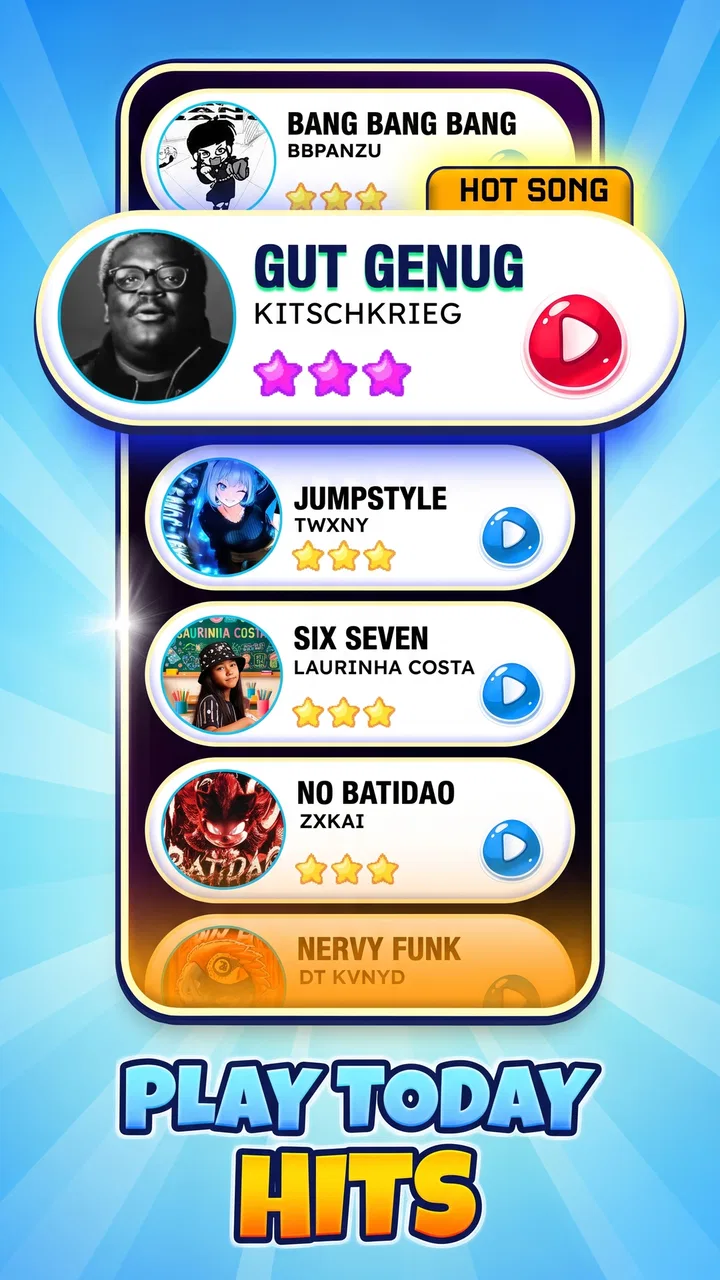
Music Piano 7: Rush Song Games is an engaging mobile app that combines the excitement of a rhythm game with the creativity of a piano simulator. It offers a wide variety of popular songs and challenges players to tap tiles in time with the music, providing a fun way to improve rhythm and coordination.
02Is Music Piano 7: Rush Song Games free to play?
Yes, Music Piano 7: Rush Song Games is free to download and play. However, it does offer in-app purchases for additional features, song packs, and to remove ads. These purchases can enhance the experience, but they are not necessary to enjoy the core gameplay.
03What are the system requirements for Music Piano 7: Rush Song Games?
For Android devices, Music Piano 7 requires Android version 5.0 or higher. For iOS users, the app is compatible with iOS 10.0 or later. Ensure your device has enough storage space for smooth performance and an uninterrupted gaming experience.
04Can I play Music Piano 7: Rush Song Games offline?
Music Piano 7: Rush Song Games can be played offline, allowing you to enjoy the game without a constant internet connection. However, certain features, such as downloading new song packs or accessing leaderboards, will require an internet connection.
05Does Music Piano 7: Rush Song Games support multiplayer or social features?
Currently, Music Piano 7 focuses on single-player gameplay, offering personal challenges and progression. While it doesn't support real-time multiplayer, players can connect with friends through leaderboards and share their scores on social media for some competitive fun.
Pros
- Intuitive interface for beginners.
- Wide selection of popular songs.
- Responsive touch controls.
- Engaging visuals and animations.
- Regular updates with new content.
Cons
- In-app purchases can be pricey.
- Ads may interrupt gameplay.
- Limited offline functionality.
- Occasional lag on older devices.
- No option to customize themes.

Music Piano 7: Rush Song Games
Gallery